
Product notes · November 2026
We have launched a new version of HomAI
Automatic repertorisation, materia medica evidence, our trained model and more, in our new analysis workflow.
By Dr. Marc L Clapers · Founder of HomAI
I repertorise every patient I see. That habit is where HomAI comes from, and it is also behind the work of the last few months.
I wanted the analysis to follow a case the way I follow it in my own practice: starting from the whole person, going down to the symptoms in the patient's own words, and ending in the texts, where a remedy is either confirmed or set aside.
This article describes the new analysis that came out of that work. Since 16 November it is the analysis every HomAI account runs, on every plan, in place of the previous one. I've written it for colleagues, so it goes into how the method works and what it changes in my daily practice.
Where the time goes in a consultation
In homeopathy we work with a large amount of very different material: repertories, materia medica, published cases and our own notes. In a real case all of it has to be crossed, and most of the time we do it in our heads, or at best with a keyword search.
The repertory helps me orient, but it speaks a language of its own, more synthetic than the patient's, and turning a story into rubrics takes time. The materia medica holds the detail I need to separate two remedies that look alike, yet with the patient in front of me it is rarely within reach.
What gets squeezed is the part that matters most, the time to reason about the case as a whole.
HomAI has always tried to give some of that time back. With the new analysis I wanted to go further: more evidence behind each remedy, a repertorisation I can trust and adjust, and a ranking I can open and question source by source.
Reading the case the way a homeopath does
The analysis starts where I start, with the whole case. Before it names a single remedy it gives an assessment: the temporal course, the nature of the disturbance, the vitality and the prognosis, a summary of the totality, and a note of what is still missing, with questions I could ask at the next visit. Names, emails, phone numbers and other identifiers are filtered out automatically before any of this happens.
Then come the symptoms. Each one is shown next to the words of the case it comes from, which matters to me because a peculiar symptom loses much of its value once it is paraphrased. They are grouped as mental, general or local, and modalities and peculiar symptoms (§153) weigh more, as they do in our own reasoning. On Basic and Pro I can correct them and run the analysis again.
Five ways of reading the same case
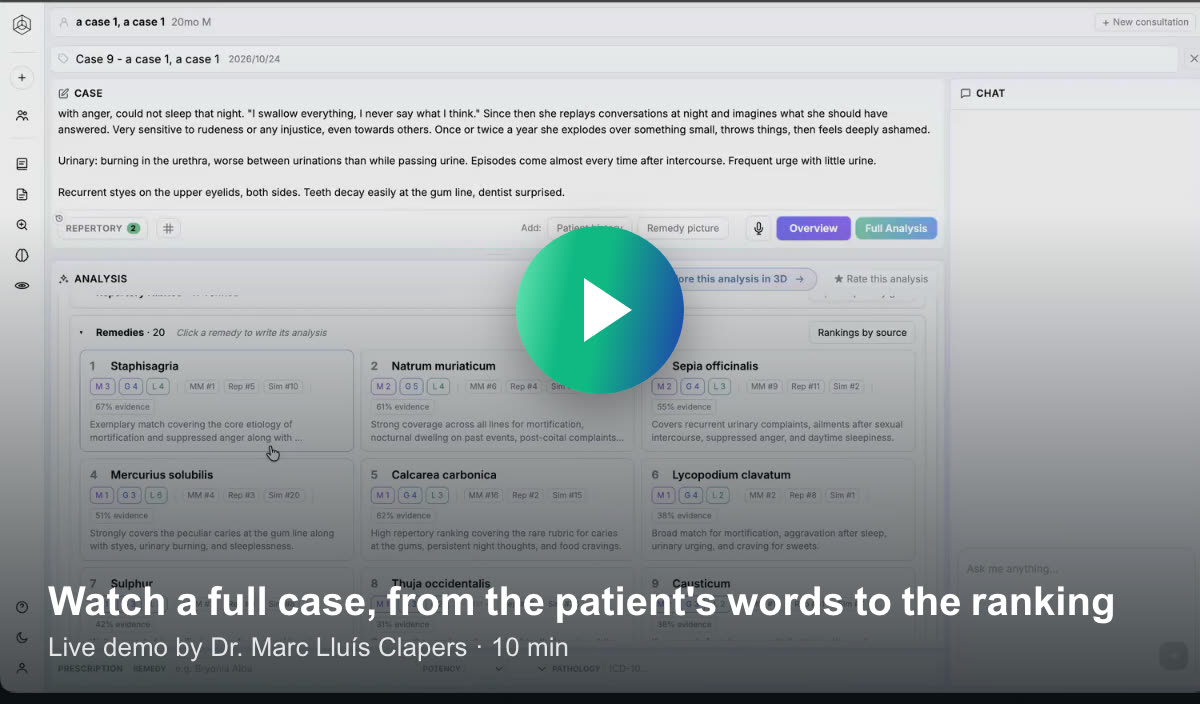
From the symptoms, the analysis reads the case in several independent ways, four on every plan and a fifth on Pro, and each one produces its own list of remedies.
The first is the repertory. HomAI writes rubrics from the case, finds them in eight public-domain repertories, with 140,197 rubrics between them, and checks each one against the case, marking it as verified, too general or too specific. What I get is a grid like the one I would build by hand, and on Basic and Pro I can change it and re-rank.
With a patient in front of me I would never work with two dozen rubrics, so I like being able to take the grid down to the ones I believe in.
The second is the materia medica. In 16 classical texts, more than 645,000 literal fragments, it looks for the passages that describe each symptom and judges every one of them against it. Only the passages that fit are shown, always with their author and work, so I can go to the source and read them in context.
The third is semantic similarity: the remedies whose materia medica is closest in meaning to each symptom, even when the words are different. It picks up what a keyword search would miss.
The fourth is HomAI-1.7B, a small language model we trained ourselves. It reads the case as a whole and proposes remedies, and when it doesn't answer in time the ranking comes out without it. Anyone with an account can also try it on its own in HomAI Lab. It is experimental and not always available.
The fifth, on Pro, is the Remedy picture, which compares the whole case with the overall picture of each remedy. It takes longer, and there is a monthly limit on how many you can run.
One ranking, with its reasons
These lists are combined into a single ranking of up to 20 remedies, with a few small remedies shown apart so they are not lost. For every remedy I can see where it stands in each source and how much of the clinical weight of the case its evidence covers.
When I click on one, its analysis is written at that moment from the quotes that were found, and if there are no verified quotes it says so.
This is where the analysis should help most, when two remedies are close. I can read the quotes behind each of them, or ask the chat which passages separate them, instead of holding both pictures in my head.
A full analysis takes a few minutes. I can follow every step while it runs, and if one part can't run, the analysis still finishes and tells me which part is missing.
A chat that reads the sources
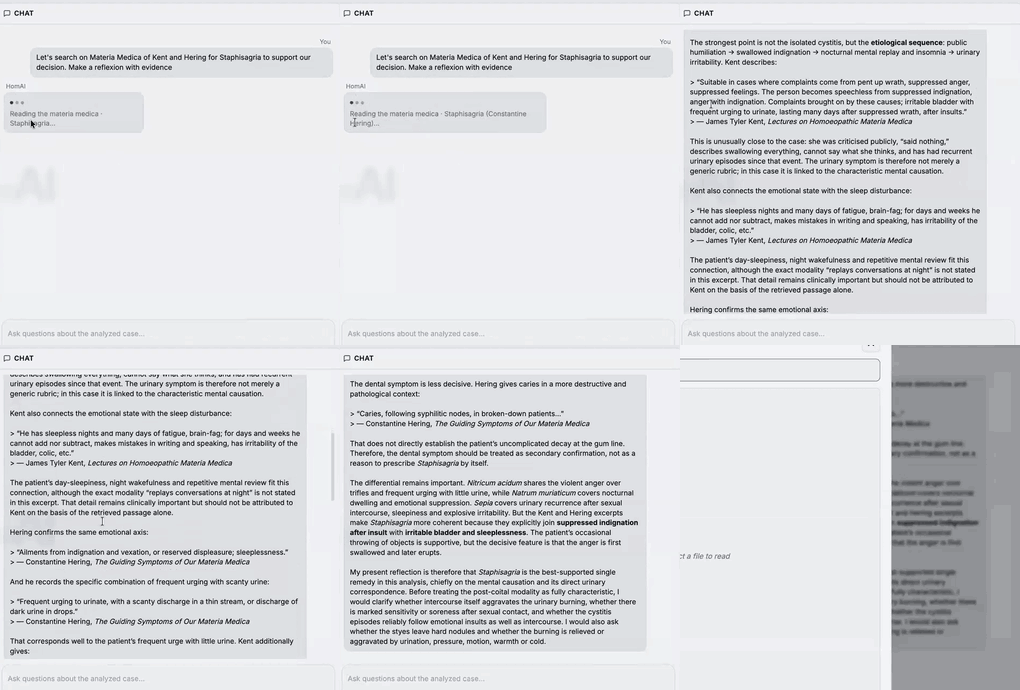
Next to the case there is a chat that uses the same sources as tools. Before it answers, it decides what to read, reads it and shows me what it is doing. When it finds nothing it says so, and when a remedy name is unclear it asks which one I mean.
Anything that would change the analysis or search the web waits for my confirmation.
It is the place for the questions that often stay open after a consultation: why one remedy rather than another, what Kent or Hering say about a modality, whether a published case resembles the one in front of me.
What it can read depends on the plan. On Free it reads the materia medica and the published clinical cases. On Basic it also searches the materia medica and the repertory, and it can edit or rerun the analysis after asking. On Pro it also uses similar published cases, semantic similarity, the Remedy picture, your own notes, the patient's history and web search.
How it feels, and what it gives me as a homeopath
Much of homeopathic practice is solitary. When I review a case on my own, doubts come up, and I am often holding the whole picture in my head while I look for one detail in a book.
The new analysis works for me like a colleague to discuss the case with. The patient's words stay next to every symptom, so the richness of how they described it survives the trip to the rubrics. The repertory grid is there when I want to check my own repertorisation, and the passages behind each remedy are one click away, with their author and work.
I still study the materia medica. The analysis makes that study quicker, and manageable with a patient in front of me.
The time that went into translating and searching goes back into the part of the work that is mine: looking at the patient as a whole, comparing the remedies that look alike, and deciding. The analysis suggests remedies and shows where each one comes from, and the prescription is still my decision.
What comes next
I'm adding more public-domain materia medica by other authors, so that each symptom has more references to draw on. After that I want to bring back the link between repertory rubrics and materia medica passages, computed in advance so it doesn't slow the analysis down. New versions of our own model will each go through a documented evaluation before they reach the analysis.
Real use will teach us the rest. When a quote fits a symptom, a thumbs up on it helps improve future analyses.
The same release brings patient management to the Basic plan: patients, visits and import.
If you'd like to try the new analysis on one of your own cases and haven't used your trial yet, it gives you every Pro feature for 14 days, without a card: no monthly limit, up to 15 full analyses a day and three Remedy pictures.
Dr. Marc L Clapers. Founder of HomAI